
Yes, Ulta Got Their Mexican Passport
But, will it grant Them permanent residency?
When Ulta made the decision in 2019 to launch in Canada, my first reaction was… What are you thinking?
Why head north to wage an extremely expensive beauty war against both Sephora and Shoppers Drug Mart? I questioned whether the potential return could justify the investment given Canada’s relatively small, but mighty spending population.
My first thought was…. why not go south and join the Queen of telenovelas? Mexico’s always camera ready for its drama queen performance, and we thank them for still wearing their full glam and crown to breakfast! Mind you, Mexico is a 65% larger beauty market than Canada and with less major like-like players.
But will Ulta’s granted Mexican Passport gain them permanent residency, or will they be deported?
Fast forward to August 2025, Ulta Beauty officially crossed the border, opening its first location at Antara Fashion Hall in Mexico City, followed just nine days later by Galerías Metepec. By January 31, 2026, Ulta had already expanded to nine stores across Mexico.
And that first location? It was an obvious opening shot at Sephora’s bow. I personally attended the store opening and PR gala when Sephora entered the Mexican market back in 2011.
Now meet Grupo Axo. Ulta didn’t simply pack up its U.S. model and head south, rather It effectively chose the same Grupo Axo playbook Sephora used to enter Mexico 15 years earlier.
Ulta Mexico operates through a joint venture with Grupo Axo, one of Latin America’s larger multi-brand retail operators, representing 60+ international brands across more than 7,000 points of sale. Ulta Beauty licenses its name and operating model, while Axo provides the local retail infrastructure. Ulta earns royalties from international sales and recognizes its share of the JV’s financial results through equity-method accounting.
Translation: Mexican register sales do not roll directly into Ulta Beauty Inc.’s consolidated U.S. top line.
Ulta brought its familiar mass + masstige + prestige + emerging + exclusive + services formula to Mexico, but not a carbon copy of its U.S. assortment. At launch, Ulta introduced 35 brands to Mexico for the first time, including Isima by Shakira, Peach & Lily, Orebella and Ulta Beauty Collection, alongside Morphe, Bubble, about-face, OUAI, Half Magic and Kitsch.
Those imports sit beside Mexican and Latino-founded brands including AHAL, AloeVida, Bailando Juntos by Yuya and Sarelly Creativo Lab by Anna Sarelly.
So What’s Hot?
Ulta is leaning heavily into fragrance, skincare, makeup and hair, with dedicated luxury and K-beauty destinations and merchandising around names including Kylie Jenner, Shakira, Sabrina Carpenter, Billie Eilish, Orebella, e.l.f., OSEA, amika, Good Molecules and OUAI.
The strategy follows the market. Circana reported 2025 prestige beauty growth across its measured Latin American markets of +30% hair, +16% makeup, +15% fragrance and +13% skincare, while fragrance represented a massive 65% of measured prestige beauty sales during the first half of 2025.
Nine Stores In, but are they making money?
Not yet, at least from what Ulta has reported. For fiscal 2025, Ulta recorded a $3.9 million equity net loss related to its Mexico JV. And here’s the important part: that $3.9 million is Ulta’s equity-method loss associated with the JV, not necessarily Ulta Mexico’s total operating loss. Ulta itself cautions that building international operations is costly and that they may not become profitable on a sustained basis. (ulta.com)
For now, Mexico is exactly what an expansion market should be at this stage: an investment, not yet a victory lap. So, what happens when those nine stores mature, the door count grows and Ulta starts taking market share? That’s where the math can get interesting.
Mexico is nearly 132 million people strong, making Mexico one of the world’s most populous consumer markets. But big population doesn’t automatically equal big beauty wallets.
Using Euromonitor’s 2025 figures, Mexican consumers generated approximately $14.8 billion in combined beauty and personal-care retail sales: approximately $11.7 billion in mass and $3.1 billion in premium. Spread across Mexico’s entire population, that’s approximately $112 per person annually, or a little over $9 per person per month. Mexican consumers may be more religious, attending mass more than Americans who, at an average, index at a much higher spend per capita $26 per month – both numbers are inclusive of each country’s TTL population.
Mexico represents only about 2%–3% of the roughly $647 billion global market.
So, who owns the beauty wallet?
Ulta isn’t exactly walking into an empty beauty box. Mexico’s retail beauty wallet is already being fought over by Sephora, with 52 stores and the country’s #1 beauty e-commerce position; Liverpool, with 193 stores; Palacio de Hierro, with 15 luxury department stores; and Sally Beauty, with 265 locations. Then top that off with Walmart, Amazon, Mercado Libre, and a long list of grocery, pharmacy, and independent beauty chains all fighting for their own piece of the Mexican Pie.
The opportunity lies in capturing share from a market that’s still developing, particularly as consumers move toward higher-priced products. And one statistic may matter more than all the others: Premium beauty grew approximately 9% in 2025 versus 5% for mass.
So, what’s the potential financial upside here aside from reaching Mexican Conquistador status?
So, let’s play with the numbers.
What If Ulta Starts Taking Share? Using our estimated $14.8 billion Mexican beauty and personal-care market as the working market size, every single percentage point of market share represents approximately $148 million in annual retail sales. For the purposes of this fun exercise lets scale this up to 9%, which may sound ambitious, and it is. But for perspective, Ulta estimates that it already captures approximately 9% of the U.S. beauty-products market.
Ulta Beauty's Mexican Market Share & Profit Potential Based On $14.8B (US Equivalence) BPC Market Size
Retail Sales & Profit Assumptions
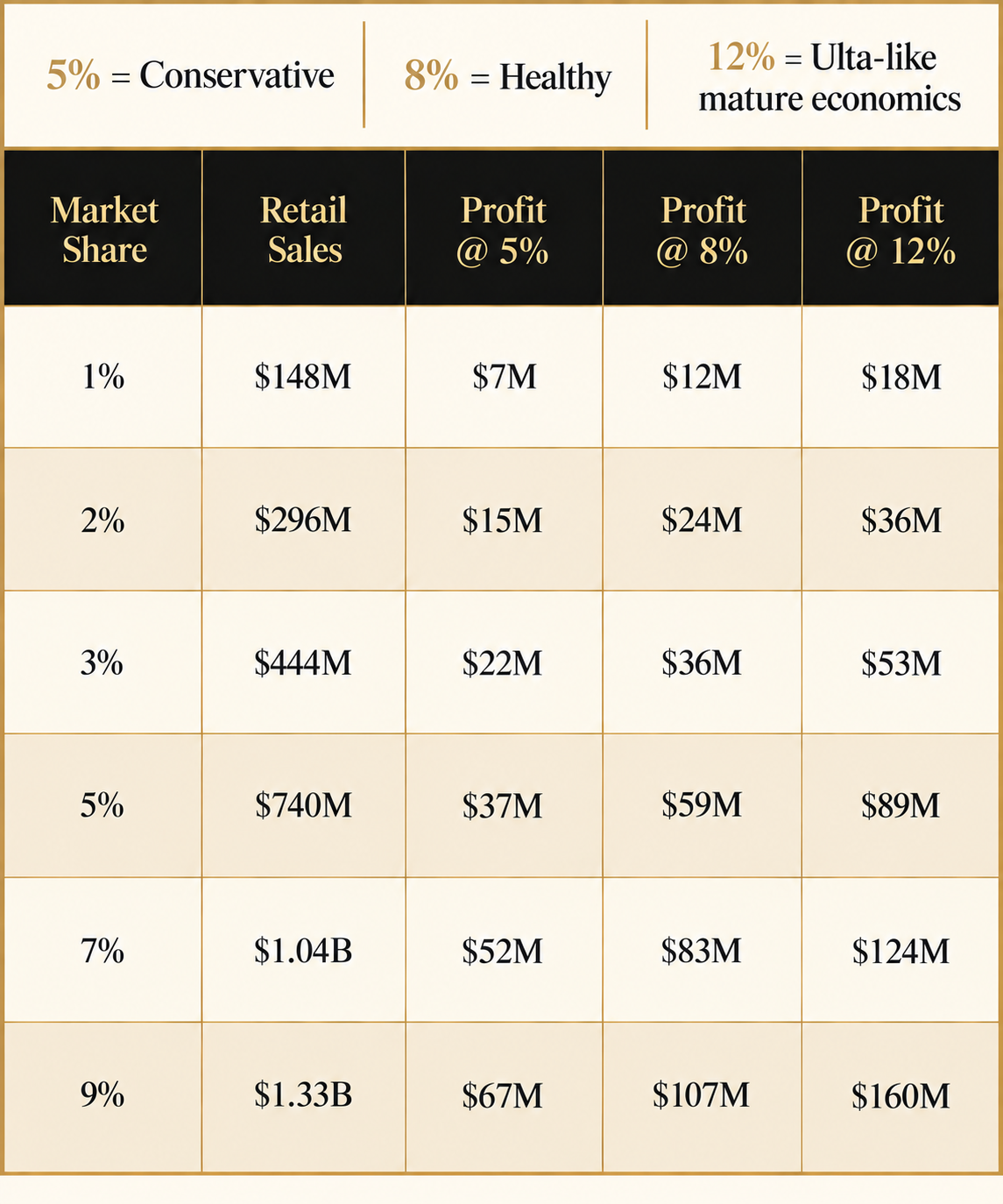
For future forecasting purposes let’s assume U.S comparative figures. Ulta’s mature U.S. business produced a 12.4% operating margin in fiscal 2025, and the company’s longer-term target remains around 12%. (ulta.com)
Mexico shouldn’t automatically be expected to perform like mature Ulta U.S. stores. There are import costs, customer-acquisition expenses, new-market overhead and an entirely different operating structure.
So instead, let’s model three potential mature and profitable Mexico margin scenarios – see profit assumptions model.
But…. Ulta doesn’t get all of it
Ulta and Grupo Axo have not publicly disclosed their respective ownership percentages, detailed profit-sharing arrangements, or royalty agreements. So, I can’t say for sure who gets what out of that TTL, but I’m sure after Sephora’s successful launch that Grupo was able to make a “Muy Guapo” deal and in their favor.
So, is Mexico worth all the work? At nine stores and with continuing startup losses, it’s too early to say yes.
But if Mexico eventually captures even 3%–5% of the country’s beauty market, achieves mature store economics in the high-single-digit margin range, and Ulta collects both royalties and its share of JV profits, Mexico could evolve from a relatively small international experiment into a $400–$750 million retail business generating tens of millions of dollars annually for Ulta.
Assuming Ulta Mexico’s online sales penetration at least matches the broader Mexican market at approximately 15%, reaching 9% of Mexico’s $14.8 billion beauty market, or roughly $1.33 billion in annual retail sales, would require approximately 140–145 stores, assuming an aggressive and mature physical-store productivity of roughly $8 million per door annually.
For comparison, Ulta U.S. generated $12.4 billion in fiscal 2025 sales across 1,505 U.S. stores. If we assume an unreported estimate/average of 25% of U.S. sales are generated online, that will put estimated brick-and-mortar productivity at roughly $6.2 million per U.S. door annually. Since Mexico indexes below US online penetration, that puts more presssure on store sales.
Using that more conservative U.S. benchmark of $6.2 million per U.S. door, Ulta Mexico could ultimately require closer to 180 stores to reach $1.33 billion in total sales, assuming approximately 15% of Mexican sales are generated online.
So, for the 300+ brands launching Ulta MX – don’t expect to become a billionaire here, but if you can get in the top 5 brands overall (MX) then you have a chance of potentially making $25M+ (sell in), once and if the market matures to the US equivalent market share scenario of 9% penetration. Let us pray!
What Are You Waiting For?
Get in the
BOXXXOXOXO!
A Big Box Beauty exclusive article written by Dominick Briguglio, CCO of Big Box Beauty published on 9/10/2026
For future forecasting purposes let’s assume U.S comparative figures. Ulta’s mature U.S. business produced a 12.4% operating margin in fiscal 2025, and the company’s longer-term target remains around 12%. (ulta.com)
Mexico shouldn’t automatically be expected to perform like mature Ulta U.S. stores. There are import costs, customer-acquisition expenses, new-market overhead and an entirely different operating structure.
So instead, let’s model three potential mature and profitable Mexico margin scenarios – see profit assumptions model.
But…. Ulta doesn’t get all of it
Ulta and Grupo Axo have not publicly disclosed their respective ownership percentages, detailed profit-sharing arrangements, or royalty agreements. So, I can’t say for sure who gets what out of that TTL, but I’m sure after Sephora’s successful launch that Grupo was able to make a “Muy Guapo” deal and in their favor.
So, is Mexico worth all the work? At nine stores and with continuing startup losses, it’s too early to say yes.
But if Mexico eventually captures even 3%–5% of the country’s beauty market, achieves mature store economics in the high-single-digit margin range, and Ulta collects both royalties and its share of JV profits, Mexico could evolve from a relatively small international experiment into a $400–$750 million retail business generating tens of millions of dollars annually for Ulta.
Assuming Ulta Mexico’s online sales penetration at least matches the broader Mexican market at approximately 15%, reaching 9% of Mexico’s $14.8 billion beauty market, or roughly $1.33 billion in annual retail sales, would require approximately 140–145 stores, assuming an aggressive and mature physical-store productivity of roughly $8 million per door annually.
For comparison, Ulta U.S. generated $12.4 billion in fiscal 2025 sales across 1,505 U.S. stores. If we assume an unreported estimate/average of 25% of U.S. sales are generated online, that will put estimated brick-and-mortar productivity at roughly $6.2 million per U.S. door annually. Since Mexico indexes below US online penetration, that puts more presssure on store sales.
Using that more conservative U.S. benchmark of $6.2 million per U.S. door, Ulta Mexico could ultimately require closer to 180 stores to reach $1.33 billion in total sales, assuming approximately 15% of Mexican sales are generated online.
So, for the 300+ brands launching Ulta MX – don’t expect to become a billionaire here, but if you can get in the top 5 brands overall (MX) then you have a chance of potentially making $25M+ (sell in), once and if the market matures to the US equivalent market share scenario of 9% penetration. Let us pray!
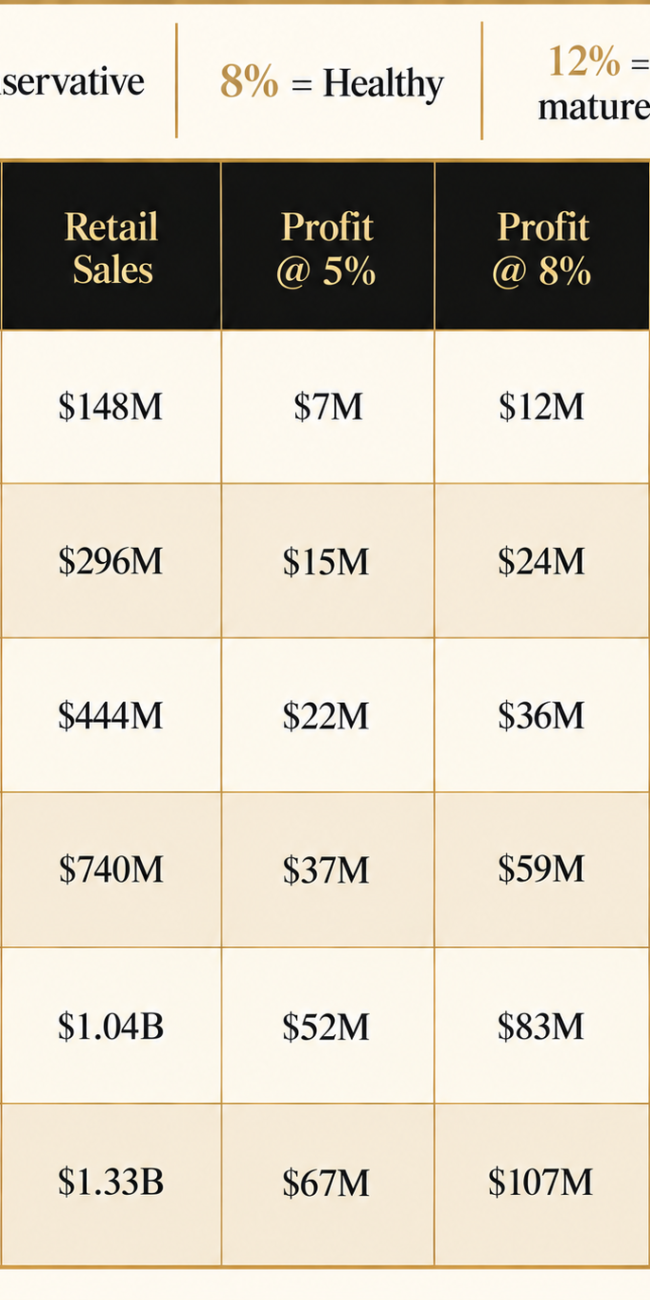
Retail Sales & Profit Assumptions
What Are You Waiting For?
Get in the
BOXXXOXOXO!
A Big Box Beauty exclusive article written by Dominick Briguglio, CCO of Big Box Beauty published on 9/10/2026
Check out our other articles
I hear it all the time! I hear it from brand founders, fellow consultants, and brand executives: read all about the culprits.
If cementing relationships with the next generation of consumers isn’t enough to get you excited about Texas, maybe the state’s overall retail growth will.
Well, we’ve got some data to show you exactly that! Check out the latest, and free, data on who’s spending the most money on beauty.
© 2026 all rights reserved Big Box Beauty LLC, a California company